



Addition Reactions
The primary reactions used in the manufacture of solvent based resins
An Addition reaction is one where two molecules are joined together to form a larger molecule consisting of all the atoms of the two reacting molecules. In other words, there are no by-products formed during the reaction, hence the term 'addition' for this reaction. These reactions are generally exothermic, in that the ingredients generate heat when reacting, and most often the reaction requires cooling.
There are 3 types of addition reactions: Anionic (Nucleophilic), Cationic (Electrophilic), and Free Radical. The reactions are indicated in Figure 1 below where Z* is the initiating species (Anionic, Cationic or Free radical) and the reactant a monomeric alkene:

As mentioned above, their are 3 types of addition reaction mechanisms which are useful for polymerisation. The following table provides examples of each:
| Type | Example Initiator | "Z" | Monomer | End Product |
|---|---|---|---|---|
| Anionic | Strong Bases such as organolithium e.g. t-butyllithium (CH3)3CLi | Z- | Alkenes with electron donating substituents e.g. vinyl monomers like Vinyl Chloride C2H3Cl | Polyvinyl Chloride (PVC) |
| Cationic | Lewis Acids such as BF3, AlCl3 | Z+ | Alkenes with electron withdrawing substituents such as Isobutylene C4H8 | Polyisobutylene (Butyl Rubber) |
| Free Radical | Organic Peroxides such as Benzoyl Peroxide, Ditertiary Butyl Peroxide etc | Z* | Alkenes in general e.g. Methyl Methacrylate C5H8O8 | Polymethyl Methacrylate (PMMA) |
Note that the value 'Z' in the above table corresponds to the Initiator 'Z' in Figure 1 above. In this instance, Z* refers to the symbol for a free radical.
Please note that addition polymerisations reactions covered further on this website will primarily cover only those produced by free radical polymerisation
| Type | Example Initiator | Structure | Cleavage Product | Phase at 25°C | SADT (°C) | Storage Temperature (°C) | Half Life (°C) | 0.1h | 1.0h | 10.0h |
|---|---|---|---|---|---|---|---|---|---|
| Azo | 2,2-azobis(isobutyronitrile) (AIBN) | .png) | 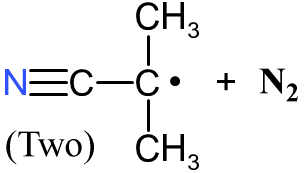 | Liquid | 50 | 25 | 101 | 82 | 64 |
| Hydroperoxide | tert-Butyl Hydroperoxide (TBHP) | 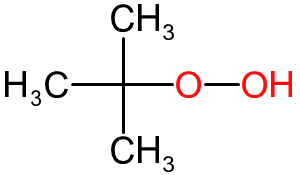 | 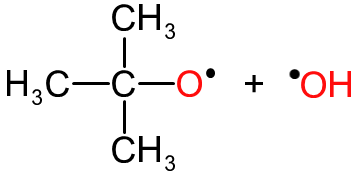 | Liquid | 80 | 35 | 207 | 185 | 164 |
| Diacetyl | Benzoyl Peroxide (BPO) | 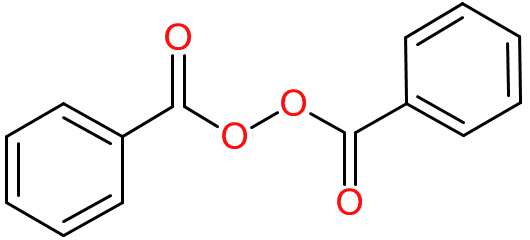 | 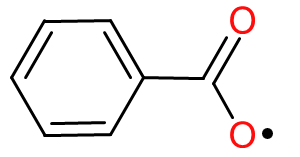 | Solid | 80 | 40 | 113 | 91 | 73 |
| Dialkyl | di-Tertiary-butyl Peroxide (DTBP) | 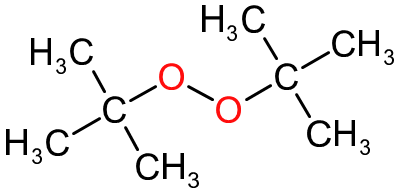 | 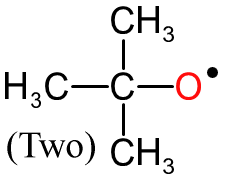 | Liquid | 80 | 40 | 164 | 141 | 121 |
| Peroxyester | t-Butyl peroxybenzoate | 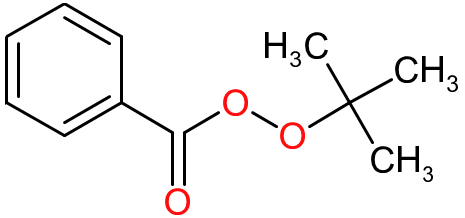 | 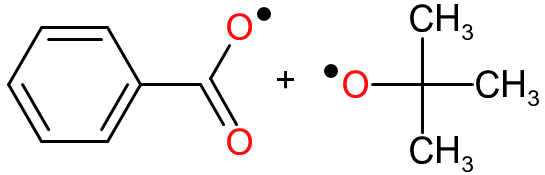 | Liquid | 60 | 25 | 142 | 122 | 103 |
Please note that the values for the various peroxides provided above can vary from one manufacturer to the next and users should ensure that they obtain the relevant data from their peroxide supplier. Peroxides are classified as explosives, and all necessary precautions should be taken as regards storage, handling and use as per the manufacturer's guidelines.
Peroxide Free Radical Formation (non-catalysed)
Within the scope of this website, only non-catalysed peroxide formulations will be discussed. As such, the generation of peroxide free radicals for polymerisation will proceed via thermal dissociation.
For example in the case of di-tertiary Butyl Peroxide the generation of free radicals would proceed as follows:

For brevity, the peroxides and their free radicals will be generically denoted by RO and RO* respectively unless otherwise depicted.
For example R-O-O-R -> 2 RO*
Addition Reaction Initiation
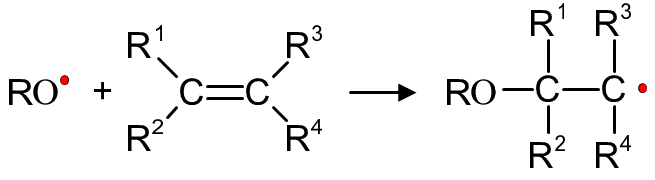
Once free radicals have been generated they react across an available double bond as in Figure 3 below:
Chain Propagation
The free radical produced in Figure 3 above is now free to react with another double bond as in Figure 4 below:

Chain Termination
Theoretically one could add just one peroxide free radical to a quantity of monomer and produce an enormous polymer chain. However, in practice, there are reactions that will restrict the chain growth by chain termination as indicated below:
Radical/Radical termination (coupling)


Key takeaway:
The higher the concentration of free radicals, the smaller the size of the polymer chains and hence molecular mass. Higher concentration of free radicals can be achieved by:
- Increasing peroxide content
- Increasing reaction temperature
- Using a different peroxide with a shorter half life at the required reaction temperature
Disproportionation

Chain Transfer

Note that there are a number of possible hydrogens that could be abstracted from the second polymer chain. The one that forms is the more stable free radical in the order 3°>2°>1°. If one of the 2° hydrogens was abstracted in the second polymer chain (i.e. CH2R to the left), the existing hydrogen from the 3° carbon would migrate to the free radical on the 2° carbon resulting in the final chain free radical position as indicated.

Chain Transfer Agents are those materials with labile hydrogens, most often mercaptans as indicated. The chain transfer agent then can act as an initiator to start another monomer free radical. The problem with mercaptans is the unpleasant odour they add to the polymer.